

World Product Day: A celebration of the people behind better products
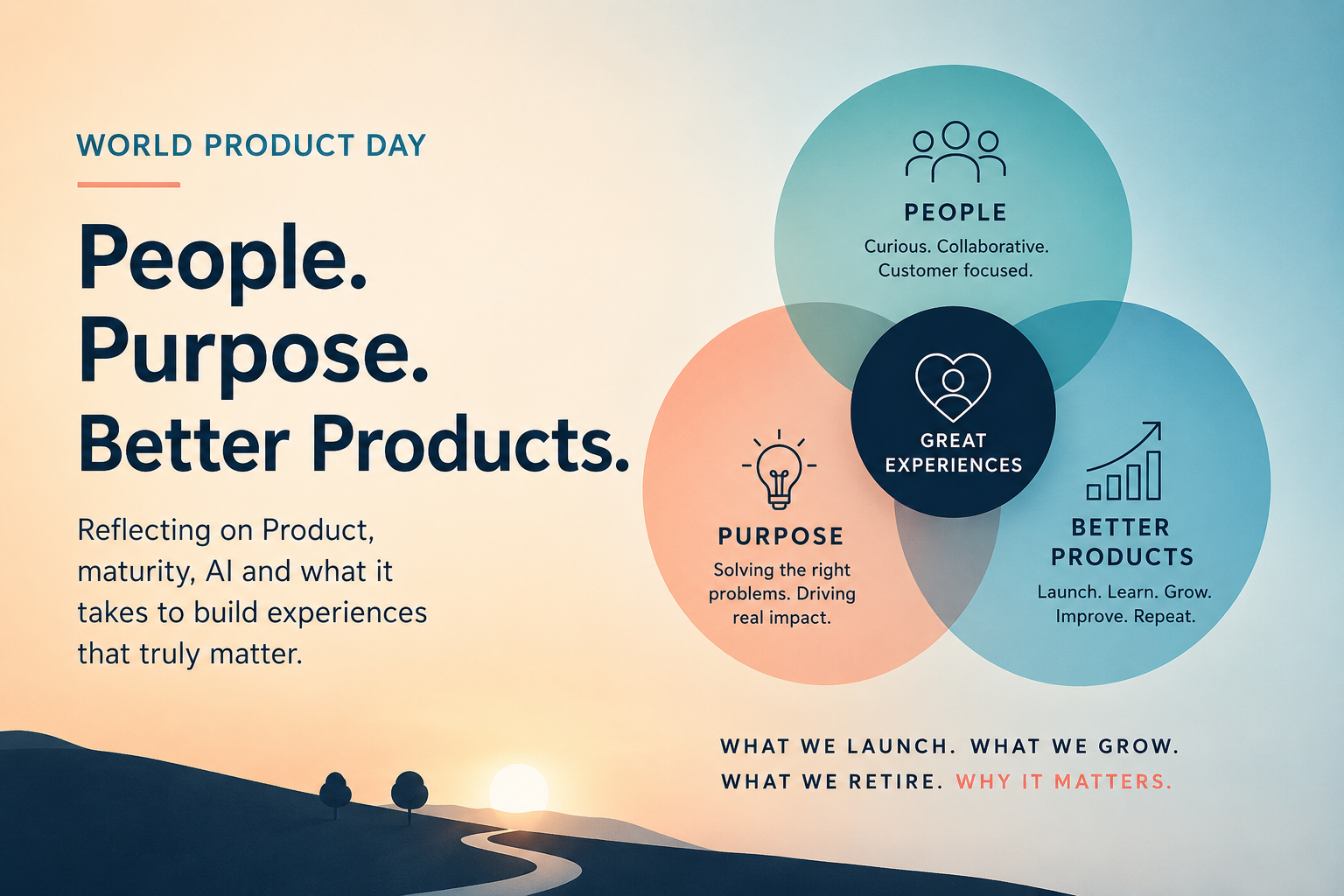
World Product Day was on 20 May, and while I’m slightly late to the party, I still wanted to mark it.
Because Product is one of those areas that can be hard to explain from the outside.
People often see the launch.
The feature.
The new button.
The shiny roadmap item.
The thing that has finally gone live.
But good Product work is so much more than that.
It is the thinking behind what we build, why we build it, how we measure it, and how we keep improving it once it is out in the world.
It is also about people.
The people asking difficult questions.
The people joining the dots between customer needs, business ambition and technical reality.
The people trying to move an organisation away from “just build this feature” and towards “what problem are we really trying to solve?”
That shift is not always easy. But when it starts to happen, it changes everything.
Product is not just about launching things
One of the biggest misconceptions about Product is that success equals delivery.
Did we launch it?
Did it go live?
Did the feature get released?
Of course delivery matters. We need to ship. We need to make progress. We need to get things into customers’ hands.
But a launch is not the end of Product work. It is part of it.
A mature Product organisation thinks about the full lifecycle:
What do we launch?
What do we grow?
What do we improve?
What do we stop doing?
What do we retire?
That last one is often overlooked.
It can feel much easier to keep adding more: more features, more content, more journeys, more tools, more campaigns, more platforms. But more does not always mean better. Sometimes the most valuable Product decision is to simplify, remove friction, or stop investing in something that no longer serves the customer or the business.
That is where Product thinking becomes powerful.
It is not about doing more for the sake of it.
It is about doing the right things, for the right reasons, and learning from what happens next.
A product-led organisation is not just a Product team
When people talk about being product-led, it can sometimes sound like something that sits neatly within the Product department.
But in reality, Product is much wider than that.
The product experience is not only the website, the app, the basket, the account area or the digital interface.
It is also:
Fulfilment.
Logistics.
Returns.
Customer service.
Pricing.
Stock visibility.
Store experience.
Communication.
Payment.
Post-purchase support.
All of these things shape how a customer feels about a business.
A customer does not separate the digital product from the operational experience. They do not think, “The website was good, but the fulfilment process is a separate department.”
They experience it as one journey.
That means Product cannot work in isolation. A strong Product organisation has to be plugged into the wider business. It has to understand the commercial ambition, the operational reality, the technology constraints and, most importantly, the customer experience.
Product is the connective tissue.
It helps translate ambition into outcomes.
It helps turn customer insight into action.
It helps create focus when there are too many ideas and not enough capacity.
It helps teams understand why something matters, not just what needs to be built.
Moving from “build this” to “what problem are we solving?”
Many organisations start from a feature-led place.
Someone has an idea.
A stakeholder asks for a feature.
A competitor has launched something similar.
A senior person wants something on the roadmap.
A team is asked to “just get it done”.
This is normal. It happens in most businesses.
But it can quickly create a feature factory: lots of output, lots of activity, lots of delivery, but not always enough clarity on whether the work is solving the right problem.
Product thinking changes the conversation.
Instead of starting with:
“Can you build this?”
We start asking:
What problem are we solving?
Who is this for?
What customer behaviour are we trying to change?
What business outcome does this support?
How will we know if it has worked?
What evidence do we have?
What is the smallest useful thing we can test or learn from?
This is not about slowing teams down. It is about reducing wasted effort.
Because building the wrong thing quickly is still building the wrong thing.
The value of Product is in creating enough structure, evidence and challenge to help teams focus on the work that matters most.
Product maturity happens in stages
I often think about Product maturity in three broad phases.
Phase one: the feature factory
This is where many organisations begin.
Ideas come in.
Features go out.
Teams are busy.
Delivery is constant.
Success is often measured by whether something launched.
There may be good intent behind the work, but the organisation is often output-led.
The risk is that teams become very good at building things without always knowing whether those things are solving meaningful problems.
Phase two: the informed product organisation
This is where better habits start to form.
Teams use data.
They speak to users.
They track behaviour.
They run A/B tests.
They review metrics.
They look at adoption, conversion, engagement, satisfaction and drop-off.
They start learning from what customers actually do, not just what people think customers might want.
This is a big step forward.
The conversation becomes more evidence-based. Product teams can challenge assumptions more confidently. Stakeholders start to see the value of insight, discovery and measurement.
This is often where product ways of working start to make a visible difference.
Phase three: the product-minded business
This is the next step change.
At this stage, Product is not seen as separate from the business. Product is how the business delivers value.
The roadmap is not just a list of features. It is a strategic tool.
Customer experience is not just a UX concern. It is a business priority.
Data is not just reporting. It is learning.
Design is not just making things look good. It is making experiences clearer, easier and more effective.
Technology is not just delivery. It is a way to unlock better customer and business outcomes.
This is where the organisation becomes genuinely product-minded.
Everyone understands that they serve the customer through the product experience, whether they work in Product, Engineering, Design, Marketing, Operations, Customer Service, Logistics or Finance.
That level of maturity takes time. It takes education, repetition, trust and proof. It also takes leaders who are willing to move beyond “what are we shipping?” and ask “what difference are we making?”
Product has to support business ambition
Customer focus and business value should not be seen as competing priorities.
Strong Product work brings them together.
A better customer experience should support the business.
A clearer journey should reduce friction.
A better account experience should increase engagement.
A stronger post-purchase experience should reduce avoidable contact.
A better returns journey should increase trust.
A better loyalty experience should encourage customers to come back.
This is why plain English matters.
Product teams need to be able to explain their work in a way the business understands.
Not just:
“We are improving the user journey.”
But:
“We are making it easier for customers to complete this task without needing support, which should reduce drop-off, reduce avoidable contact and improve repeat usage.”
Not just:
“We are redesigning this page.”
But:
“We are removing friction from a high-value journey so customers can find what they need faster and complete the action with more confidence.”
Not just:
“We need to do discovery.”
But:
“We need to reduce the risk of building the wrong thing by understanding the customer problem before we commit time and investment.”
That is the real value of Product communication.
It connects the work to outcomes.
OKRs can help, but only if they are meaningful
OKRs can be a brilliant way to connect Product work to business ambition, but only when they are used properly.
The strongest OKRs help teams focus on outcomes, not just activity.
They create a clear link between:
What the business is trying to achieve.
What customer behaviour needs to change.
What the team is working on.
How success will be measured.
For Product teams, this can be incredibly useful.
It means we are not just saying, “We delivered the feature.”
We are asking:
Did it improve the experience?
Did it change the metric?
Did customers use it?
Did it reduce friction?
Did it support the commercial goal?
Did it teach us something valuable?
This is also where Product can help businesses talk about performance in a more useful way.
Not everything needs to be wrapped in complicated terminology. In fact, the more senior or cross-functional the audience, the more important plain English becomes.
The real question is simple:
What changed because of the work we did?
AI is changing Product, but it does not remove the need for Product thinking
We are also working through a huge AI shift.
AI is changing how teams research, analyse, write, build, test and support products. It is speeding up parts of the Product lifecycle and creating new opportunities for automation, personalisation and insight.
Product teams should absolutely lean into this.
We should be exploring how AI helps us work better.
How it helps us understand feedback faster.
How it supports discovery.
How it helps identify patterns.
How it improves internal workflows.
How it can create better customer experiences.
But AI also makes Product thinking more important, not less.
Because when it becomes easier to build, generate and automate, it becomes even more important to ask:
Should we?
Why does this matter?
Who does this help?
What risk does it introduce?
What problem are we solving?
How will we know if it is valuable?
How do we keep the human experience at the centre?
AI can accelerate delivery, but it should not replace judgement.
The role of Product becomes even more important in helping businesses separate useful innovation from noise.
The best Product teams are deeply immersed in the experience
For me, great Product work comes from being close to the experience.
Not just looking at dashboards.
Not just reading requirements.
Not just sitting in planning sessions.
But really understanding what customers are trying to do.
Watching journeys.
Reading feedback.
Listening to customer service teams.
Speaking to colleagues who are closest to the pain points.
Looking at where people drop off.
Understanding the operational reality.
Seeing how the digital and physical experience connect.
That is where the best insight often comes from.
Because customers do not experience businesses in neat internal silos. They experience moments.
Can I find what I need?
Can I trust this information?
Can I complete the task?
Can I get help if something goes wrong?
Will this business remember me?
Will I come back?
Product teams need to care about those questions.
Day after day. Year after year.
Product is also about how teams work
Product is not only about what we deliver. It is also about how we work.
Are teams clear on priorities?
Are stakeholders aligned?
Are we making decisions with enough evidence?
Are we learning from releases?
Are we improving the way we collaborate?
Are we making it easier for the business to engage with Product?
Are we creating momentum without creating chaos?
For me, Product is not only about building and releasing new features. It is also about tracking what we deliver, learning from it, and improving how we work, from team effectiveness to business engagement and change.
Finding ways to improve in a meaningful way without slowing things down is always a challenge, but it can deliver strong results.
Small improvements in ways of working can have a big impact.
Better prioritisation.
Clearer decision-making.
Stronger discovery.
More useful metrics.
Tighter feedback loops.
Better communication.
More joined-up thinking between teams.
These things may not always be as visible as a launch, but they are often what makes sustainable delivery possible.
So, what should we celebrate on World Product Day?
For me, World Product Day is not just a celebration of Product Managers.
It is a celebration of Product teams.
The researchers, designers, engineers, analysts, delivery leads, marketers, customer teams, operational teams and stakeholders who all contribute to better outcomes.
It is a celebration of the people doing the hard work behind the scenes.
The people making sense of ambiguity.
The people challenging assumptions.
The people connecting customer needs with business goals.
The people making trade-offs.
The people learning from what did not work.
The people trying to make the next version better.
Product work is rarely perfect. It is messy, complex and often full of competing priorities.
But when it works well, it helps organisations build things that matter.
Not just things that launch.
Things that solve problems.
Things that customers value.
Things that support the business.
Things that keep improving.
That is worth celebrating.
Enjoyed this? Why not read https://www.emilywilkinson.co.uk/blog/what-okr-coaching-taught-me-about-product-thinking next.
Mind the Product’s World Product Day page describes the day as a global celebration of Product people, stories and progress. Productboard’s Product Excellence model is useful for backing up the sections on deep customer insight, clear strategy and roadmaps.